Twipe Insights
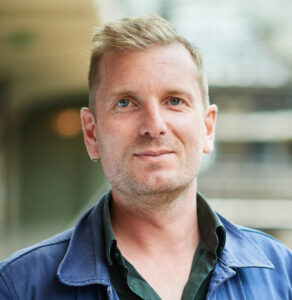
Exclusive Interview with Karel Dierickx, Head of Audio & Video at Mediafin
For decades, news was something you held in your hands. Today, it’s just as likely to be something you hear or watch.
Karel Dierickx is Head of Audio & Video at Mediafin, the publisher behind Belgian dailies De Tijd and L’Echo. He’s aware the conversation about that shift is just getting started. Ahead of his talk at the Digital Growth Summit in Leuven on 15 October, I asked him what audio and video can do that print can’t.

“You have to go where the audiences are.”
Mediafin’s titles are legacy print brands with a big following, a growing one even. However, it is also an ageing one. The need was spotted before Karel arrived: the papers wanted “touch points with other audiences,” and in 2021 they hired him to set up an audiovisual team and build the strategy to go with it. Both launched a daily podcast, De 7 at De Tijd and Le Brief at L’Echo.
It worked. “Over 80% of the audience of the dailies are younger than 44, which is very complementary to the print-digital newspaper audience, which would be around 55,” Karel says, citing Spotify data (Apple Podcasts doesn’t disclose age). Video skews younger still, particularly short form, though he admits they were “fairly new, fairly late” to it.
He’s candid about the timing on audio too. The New York Times had already launched The Daily, which he dates to early 2017 and De Standaard, a newspaper in Flanders, started a daily podcast in 2018. “So we were [a few years] behind big news outlets,” he says. “However late we were, it was time to start with it.”
Following your audience can be daunting for publishers wary of handing control to a platform whose policy might change next quarter (we’re looking at you, X and Facebook). Karel’s version of the move is less exposed than it sounds. Mediafin took the format and brought it home. “We took the language and the grammar of social video,” he says, meaning short form built for a phone, “and we embedded this on our own platforms,” the website and the app. A younger reader who recognizes the style then finds it somewhere Mediafin owns.
“Some stories have a bigger impact if you translate them into audio.”
A change of format doesn’t mean losing your identity. “There are stories that beg for a video instead of a text, and the other way around as well,” Karel says. “There are still some stories that are best explained through a text.”
What audio adds is intimacy, something harder to mimic on a newspaper page. “It is the most intimate form of media,” he says. “The listener chooses deliberately to listen to this podcast.” People are actively choosing the content. “It is really a decision of a user to start listening to you with the intention to stay with you.” The relationship between the publisher and the listener becomes inevitably stronger.
Print rarely gets that. Research has shown, he says, that readers start with a headline and 60% don’t go on to the next one. The next way in is a pull quote or an image, “and then another 30% drops off, and then perhaps you stay with 20%” who actually read the article.
Audio builds a relationship with a person instead. De 7 is hosted by Bert, who came to De Tijd from public broadcaster VRT with a voice listeners already knew, and who went on to run the political side of the newsroom. “Bert became a synonym for De 7 and De 7 became a synonym for Bert,” Karel says. Talk to listeners and “they always start talking about Bert,” rarely about the show itself.
A newsroom that writes, records and edits
Around 90% of Mediafin’s newsroom is still very much oriented towards writing, Karel admits, but the new generation already writes, records audio and edits video. “It is because the audiences dictate us into that way.”
AI is part of the toolkit. Beyond subtitles and dubbing, Mediafin’s videographers trained a GPT of their own: feed it an article and it returns three possible hooks to open a video with, “like some kind of brainstorm companion.” The team also uses AI to enhance low-quality footage and generate images.
And no, this is not the end of the text. “It is not that people are reading less. People are reading in other ways,” Karel says. “People are still reading.” What’s changed is where they encounter it, including in the answers LLMs give them. That’s where he sees a threat: AI systems built on publishers’ content. One of the answers might be a deal. “If you want to use our content, no problem, you will have to pay for it. Just like subscribers pay for content.”
Understand where your journalism works best
Winning new audiences isn’t about producing more video or audio. It’s about knowing which format serves each story, and who should tell it. Get that right and nothing is lost in the move. Text, audio and video start working as one thing.
Karel is speaking at the Digital Growth Summit in Leuven on 15 October, where he’ll go further into how Mediafin built its audio and video strategy and what it changed in the newsroom.
He’s one of 140+ media people in the room that day, alongside C-levels and product leaders from Le Monde, Kleine Zeitung, FAZ, The Guardian, Mediahuis, and many more.
Register today: https://www.twipemobile.com/twipe-digital-growth-summit-2026/
Other Blog Posts


Stay on top of the game
Join our community of industry leaders. Get insights, best practices, case studies, and access to our events.
"(Required)" indicates required fields