Every Digital Growth Summit has a few of what I think of as mystery speakers. They are the people on the program who do not work in news and have rarely, if ever, been asked to address a room full of publishers. They are also the sessions people quote at the drinks afterward, because a room where everyone does your job tends to share your assumptions, including the wrong ones. Here is what two of those outsiders left us with.
Himpens: start from the problem and the impossible answer turns up
Joris Himpens is General Manager of Lab of Tomorrow, the innovation arm of Tomorrowland (a large electronic music festival in Belgium). You might reasonably be wondering what a music festival has to do with a news organization. Here is the story that answers it.
Tomorrowland’s Atmosphere stage had poles running down the middle of the tent, standing between the crowd and the DJ. That was the problem — not a technical specification, just something that was wrong with the experience. The engineering answer was that a tent of that size without poles could not be built. The creative team told them to think again, and the answer turned out to be an external anchoring method that already existed in other industries and had simply never been used at a festival.
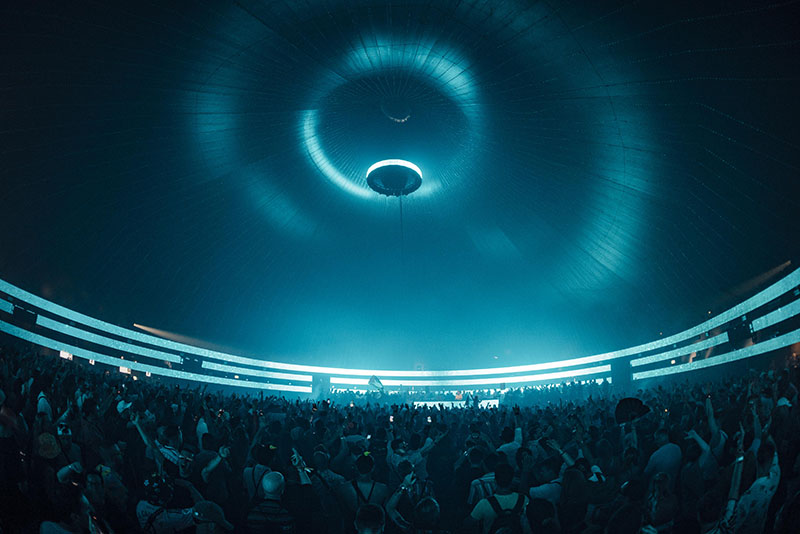
What matters is what the team refused to do. They did not start from what was buildable and work forward to the best available version, which is how the poles got there in the first place. They started from the problem and stayed on it long enough for the constraint to turn out to be a convention rather than physics.
Most product constraints in a newsroom have that shape. Not impossible, just never done this way by people who mostly talk to each other. Himpens’ own phrasing was to work backwards: decide what you want the reader to experience, then go and find out what has to exist for that to happen.
Becks: you are selling infrastructure and charging like a content supplier
Bart Becks is familiar with the news industry, having spent enough time around media to know how it works. But he also runs the AI venture Genisys and sits on the board of the European Innovation Council, which puts him far enough from the newsroom to see the whole board rather than one square of it.
He walked through the AI stack and marked off what Europe has already lost at a macro-level. Energy is gone, because European electricity is not price-competitive. Chips are gone, because catching the American and Chinese manufacturers is not realistic. Infrastructure, models, apps and data are still open.

His point about publishers came next. Trusted, local, multilingual, verified reporting is the one input the models cannot generate for themselves, and he called it strategic infrastructure rather than content. That sounds like a compliment. It is really a pricing argument, and the difference is worth spelling out.
Content is sold the way stock photography is sold. You license a body of material, you agree a number, and the money arrives once. The price does not move when the buyer’s product becomes more valuable or starts getting used ten times as often, and the buyer sets the terms because there is always another seller.
Infrastructure is sold the way cloud capacity is sold. The fee recurs and it scales with how much the thing is actually used. Nobody signs a one-off check for their database layer.
Most AI licensing deals signed in the past two years price the material the first way while it behaves the second way. Becks’ own answer to that was collective: fund a shared layer at sector level and co-invest through channels that already exist, rather than each title negotiating alone. It is also where both CEOs on the day ended up, by a different route.
The version a product team can act on is smaller. Find out how often your reporting is actually being drawn on, because that number is the one every pricing conversation is missing.
One instruction, twice
Becks and Himpens gave the room the same instruction from opposite ends. Start from what is true outside your building — what the buyer actually depends on, what the reader actually experiences — rather than from the category you inherited. Both the pricing model and the poles in that tent were defaults: decided once, under conditions that have since changed, and never reopened.
Other Blog Posts


Stay on top of the game
Join our community of industry leaders. Get insights, best practices, case studies, and access to our events.
"(Required)" indicates required fields